


Specialist Support Coordination
Who This Service Is For?
Specialist Support Coordination is designed for NDIS participants whose situations involve significant complexity, multiple services, high risk, or barriers that require a more intensive level of coordination and oversight.
This service may be appropriate for participants who are:
Managing complex support environments involving multiple providers or services
Experiencing housing instability, crisis situations, or service breakdown
Requiring coordination across health, justice, mental health, housing, hospital, or community systems
Transitioning from hospital, justice, supported accommodation, or other high-support environments
Navigating complex behavioural, psychosocial, neurological, physical, or cognitive support needs
Requiring advocacy, risk management, or stronger coordination oversight
Preparing for plan reassessments, reviews, change of circumstances, or significant transitions
Experiencing barriers accessing appropriate services and supports
Requiring structured coordination to stabilise supports and reduce ongoing risk
Specialist Support Coordination is designed to help participants, families, and providers bring clarity, structure, and direction to situations that are often difficult to navigate alone.
What Is A Support Plan?
As your Specialist Support Coordinator, I develop a detailed Support Plan tailored to your specific situation. This is not a generic document — it is a practical working plan built around the real risks, barriers, goals, and supports in your life.
Together, we:
Identify the complexity of your situation and the risks involved
Clarify the roles and responsibilities of everyone involved
Map current services and identify critical gaps in support
Set clear priorities, actions, and realistic timelines
Develop early warning signs and crisis response strategies
Ensure your NDIS funding is being used effectively and strategically
This plan is a living document that is reviewed and updated as your situation, supports, and goals evolve.
How To Get Started?
Step 1: Contact NWU - Navigate With Us directly or ask your Support Coordinator, LAC, planner, family member, or provider to send a referral.
Step 2: We arrange an initial consultation to understand the participant’s situation, risks, current supports, and what needs to be stabilised.
Step 3: If Specialist Support Coordination is the right fit, we complete a Service Agreement and begin gathering the information needed to understand the full picture.
Step 4: A Support Plan is developed and reviewed over time, with ongoing coordination focused on stability, risk management, service connection, and practical outcomes.
Specialist Support Coordination In Real Life
Speciali Specialist Support Coordination is an NDIS-funded support for participants whose situations involve significant complexity, high risk, multiple services, or barriers that require a more intensive level of coordination and oversight.
This is not simply about linking services together. It is about helping participants, families, and providers navigate situations where supports may be unstable, systems are difficult to manage, or important decisions need careful coordination.
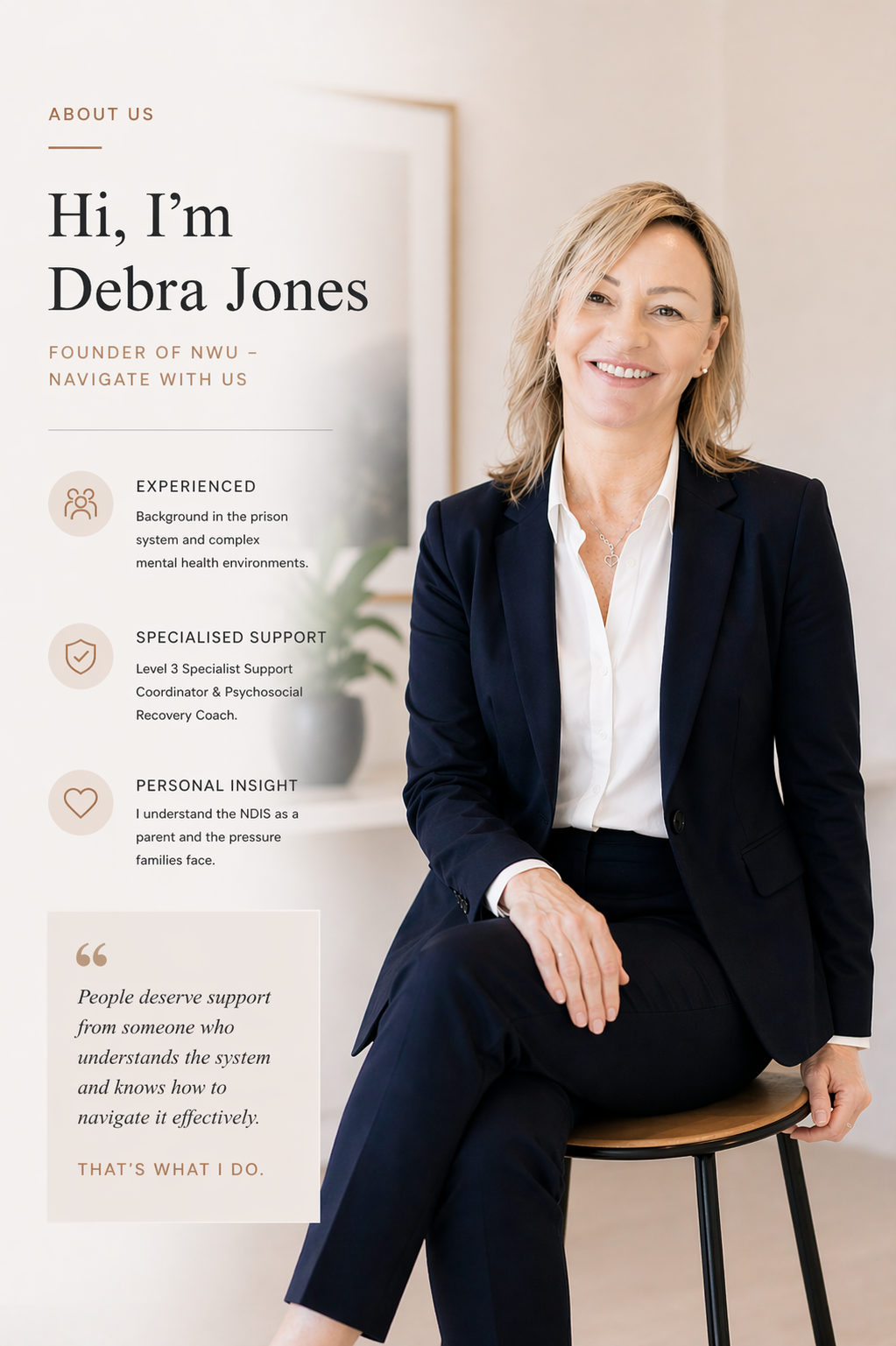
At NWU – Navigate With Us, Specialist Support Coordination is grounded in over 20 years’ experience across corrective services, youth justice, complex support environments, community services, and the NDIS.
I work alongside participants, families, providers, and multidisciplinary teams to bring structure, clarity, and direction to situations that often feel overwhelming or difficult to stabilise.
This can include:
Coordinating multiple providers and support systems
Crisis prevention and risk management
Hospital discharge and transition planning
Housing and accommodation support pathways
Support during service breakdowns or complex transitions
Preparing for NDIS reviews, reassessments, and change of circumstance requests
Strengthening communication and accountability between services
Building practical support structures that are sustainable long term
Every situation is different. My role is to look at the bigger picture, identify what is working and what is not, reduce unnecessary complexity, and help create support systems that are realistic, stable, and capable of holding over time.
Specialist Support Coordination through NWU is delivered face-to-face across Sydney’s Eastern Suburbs and surrounding areas, with a hands-on approach for participants requiring higher-level coordination and oversight.
Specialist Support Coordination Designed for people who need more than surface level support.
*
Specialist Support Coordination Designed for people who need more than surface level support. *
I work alongside participants, families, and providers to bring clarity, structure, and direction to situations that are often difficult to navigate.
My approach at NWU – Navigate With Us is grounded in over 20 years of professional experience across corrective services, youth justice, complex support environments, community services, and the NDIS. I understand how systems operate, where gaps occur, and what is required to build supports that are practical, stable, and sustainable over time.
Every engagement is focused on the participant, their circumstances, their risks, and what needs to happen to create greater stability and stronger coordination. I look at the bigger picture and work systematically to strengthen support structures, improve communication, and reduce unnecessary complexity.
Specialist Support Coordination through NWU – Navigate With Us is delivered face-to-face across Sydney’s Eastern Suburbs and surrounding areas. This is a hands-on service focused on practical engagement, consistent oversight, and real-world coordination.
This is not a one-size-fits-all approach. It is tailored, high-level coordination for participants navigating significant complexity in their lives.

What Does Level 3 Specialist Support Coordination Look Like?
Level 3 Specialist Support Coordination is not just about managing paperwork. It is about understanding the complexity of a participant’s situation and coordinating the right supports to create stability, direction, and meaningful progress.
As we work together, I will:
Conduct a thorough assessment of your situation, risks, support needs, and current service arrangements
Develop a detailed Support Plan that reflects the complexity of your circumstances
Identify and engage suitable services and providers for your specific needs
Respond to crisis points and help stabilise supports when issues arise
Work with hospitals, justice services, mental health services, housing providers, and other key stakeholders where required
Coordinate communication across services so important details do not fall through the cracks
Provide clear evidence to the NDIA regarding progress, barriers, risks, and support needs
Work with family members, carers, and providers so everyone understands the plan and their role
Specialist Support Coordination is intensive, high-level work. It is designed for participants whose situations require strong coordination, clear systems, and experienced support to navigate complex service environments.
What Is The Difference Between
Specialist Support Coordination
&
Psychosocial Recovery Coaching?
Specialist Support Coordination and Psychosocial Recovery Coaching are separate NDIS supports, although some participants may have both included in their plan.
Specialist Support Coordination focuses on managing complex support environments, reducing risk, coordinating multiple services, and helping stabilise situations that require higher-level oversight and system navigation.
Psychosocial Recovery Coaching focuses more specifically on mental health recovery, capacity-building, resilience, and helping participants strengthen daily living skills and long-term recovery goals.
The two supports can work alongside each other where appropriate, depending on the participant’s needs and NDIS funding.
How To Get Started
Specialist Support Coordination Level 3 is funded under the Capacity Building – Support Coordination budget within your NDIS plan under item 07_004_0132_8_3.
If Specialist Support Coordination is not currently included in your plan, you can discuss this with your LAC, Support Coordinator, or NDIS planner at your next review.
Step 1: Contact NWU – Navigate With Us directly or ask your LAC, planner, Support Coordinator, or provider to send a referral.
Step 2: We review your situation, current supports, risks, barriers, and overall support needs.
Step 3: A detailed Support Plan is developed to create clearer structure, coordination, and direction.
Step 4: Ongoing coordination is provided across services, providers, and support systems to help stabilise the situation and build longer-term outcomes
Frequently Asked Questions
*
Frequently Asked Questions *
-
Answer: Specialist Support Coordination is a higher level of Support Coordination for NDIS participants with complex needs. It is for people whose situations involve significant barriers, high risk, or multiple services that require expert navigation. It is not the same as standard Support Coordination.
-
Answer: Standard Support Coordination helps participants understand and implement their NDIS plan. Specialist Support Coordination Level 3 is for situations where the complexity is significantly higher — where the risks are real, the system is difficult to navigate, and getting it wrong has serious consequences.
-
Answer: Participants who have complex or high intensity support needs, face significant barriers using their NDIS plan, require coordination across multiple agencies, or are experiencing crisis or unstable living arrangements. This includes people transitioning from psychiatric hospitalisation, involvement with the justice system, or at risk of homelessness.
-
Answer: Check your NDIS plan for item 07_004_0132_8_3 under Capacity Building — Support Coordination. If you're unsure, ask your LAC or planner.
-
Answer: If you're living with a mental health condition that affects your daily life and you need more than plan management — consistent, structured support focused on your actual recovery — then this is likely a good fit. Get in touch and we'll have an honest conversation about whether I'm the right person to support you.